
Increasing interest in canola in the northern region as a rotation crop has highlighted an often unforeseen pest management risk for nearby establishing cotton crops posed by Rutherglen bugs (RGB).
Rutherglen bug adults are frequently encountered in cotton when conducting beat sheet assessments, particularly during late spring, and in some years, numbers can be quite high.
High numbers of RGB or the closely related grey cluster bugs in squaring or early flowering cotton have raised questions about the potential for damage and impact on retention, and two studies were undertaken to examine whether adult Rutherglen bugs cause damage to squares and bolls. These studies involved caging large numbers of insects onto fruiting structures and assessing the impact on retention and quality of the subsequent boll produced. In each instance there was no impact on the boll even when high numbers (>50 adults) were caged onto single fruiting branches. While bolls within this scenario were blemished by Rutherglen bug feeding, this did not translate into damage to the developing seed or lint. Interestingly in these experiments, the Rutherglen bugs did not persist for long periods when caged on cotton and under field conditions Rutherglen bugs have not been observed to breed in cotton, indicating that. cotton is not a preferred host compared to crops such as sunflower, sorghum and canola.
However, there is a unique situation where Rutherglen bugs can significantly impact cotton crops.
This occurs when large numbers of flightless, starving Rutherglen bug nymphs are displaced just prior to or in the weeks after harvest from a crop with a resident population and move onto an adjacent field of emerging or seedling cotton. This is most often observed when canola has been grown, and cotton is sown directly beside or into the same field post-harvest.
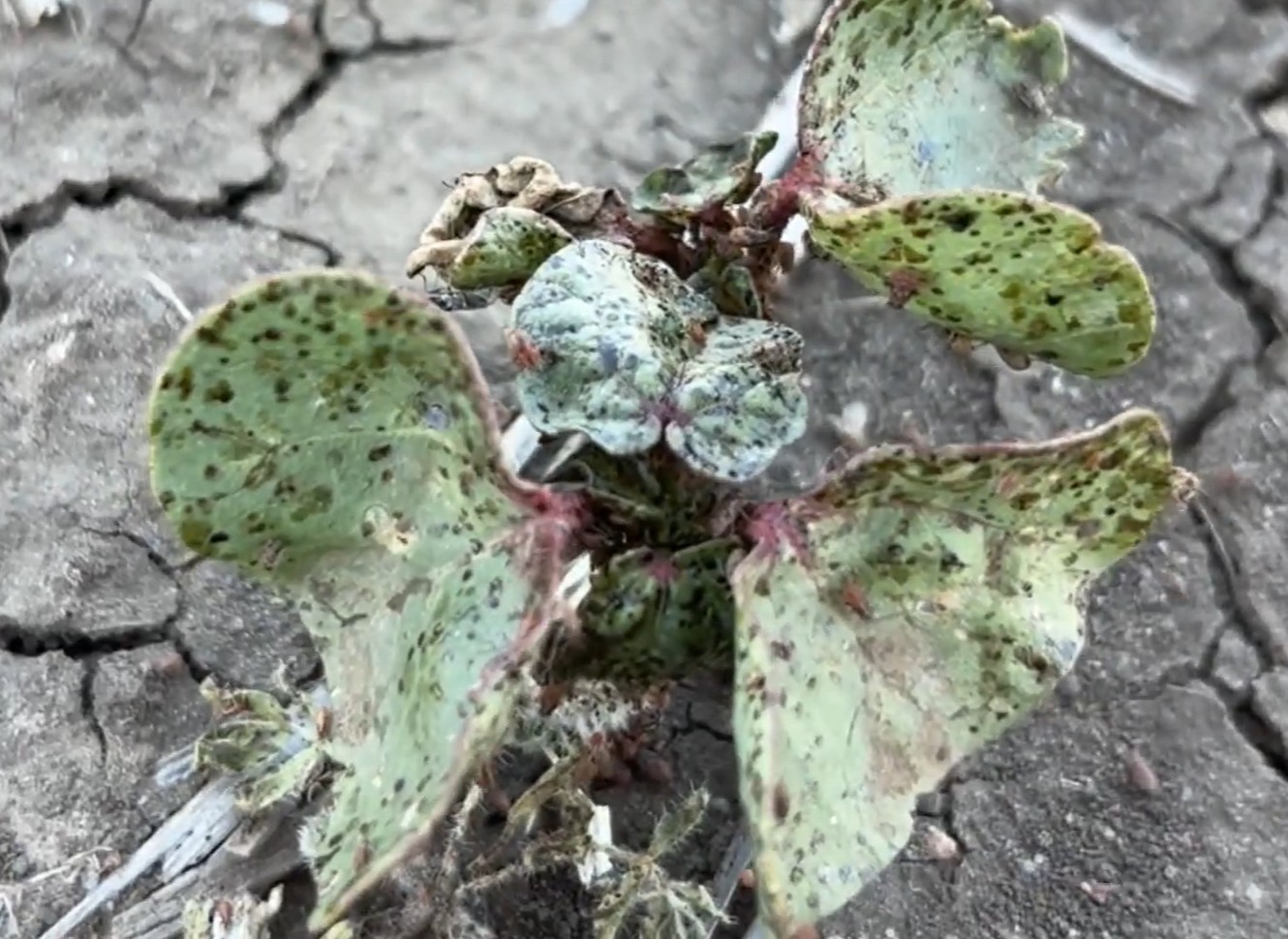
Most canola crops in the northern region will become a host to large numbers of Rutherglen bugs, particularly during the later crop stages. Nymphs and adults can persist in fields after harvest, feeding on any green canola stems that remain. As these stems dry down, adults will fly to other areas, but the nymphs (that are wingless) are forced to move on foot in search of food. Literally millions of hungry nymphs can begin to disperse from the canola field to nearby areas, feeding on whatever green plants they can find. Seedling cotton, despite being a non-preferred host, can be rapidly decimated by the sheer weight of numbers. Damage manifests as seedling discolouration, followed by dehydration and death as a result of the feeding pressure, often in as little as 4-7 days. Standard seed treatments used in cotton provide no efficacy against this scenario. Plants can remain susceptible to damage from displaced nymph populations up until they are about 6-7 nodes.
What is the solution?
Managing the impact of Rutherglen nymphs on seedling cotton once migration has occurred is very difficult. Spraying cotton fields has been reported to have limited impact, particularly when numbers are high and the cotton crop is so small.
Ideally, avoid planting cotton directly beside canola fields.
If this is not possible, inspect the canola fields and post-harvest residues for signs of Rutherglen bugs. The numbers involved are typically high and easy to find. If large numbers are present, the risk to an adjacent emerging crop will be high, particularly post-harvest. In this scenario, delay planting cotton if possible until the population has developed into adults and can emigrate elsewhere.
Because the nymphs can only move by walking, natural barriers such as channels filled with water could prevent nymphs from crossing over. Insecticide applied to the ground to form a barrier strip has generally only limited efficacy. Similarly, cultivating the ground between the two crops may only provide short term relief.
The key thing is to be aware of the risk, and both plan and act accordingly.
Content prepared by CottonInfo IPM Technical Lead, Paul Grundy.
Rutherglen bug and grey cluster bug are native, highly migratory sporadic species that can build to large numbers when conditions are favourable. In this short video, nymphs that have emerged from a neighbouring canola field can be seen on seedling cotton. Watch here: Rutherglen bug nymphs in seedling cotton - YouTube